
Introducing Zenith: Zano's move to pure Proof of Stake
-
Introducing Zenith: Zano's move to pure Proof of Stake.
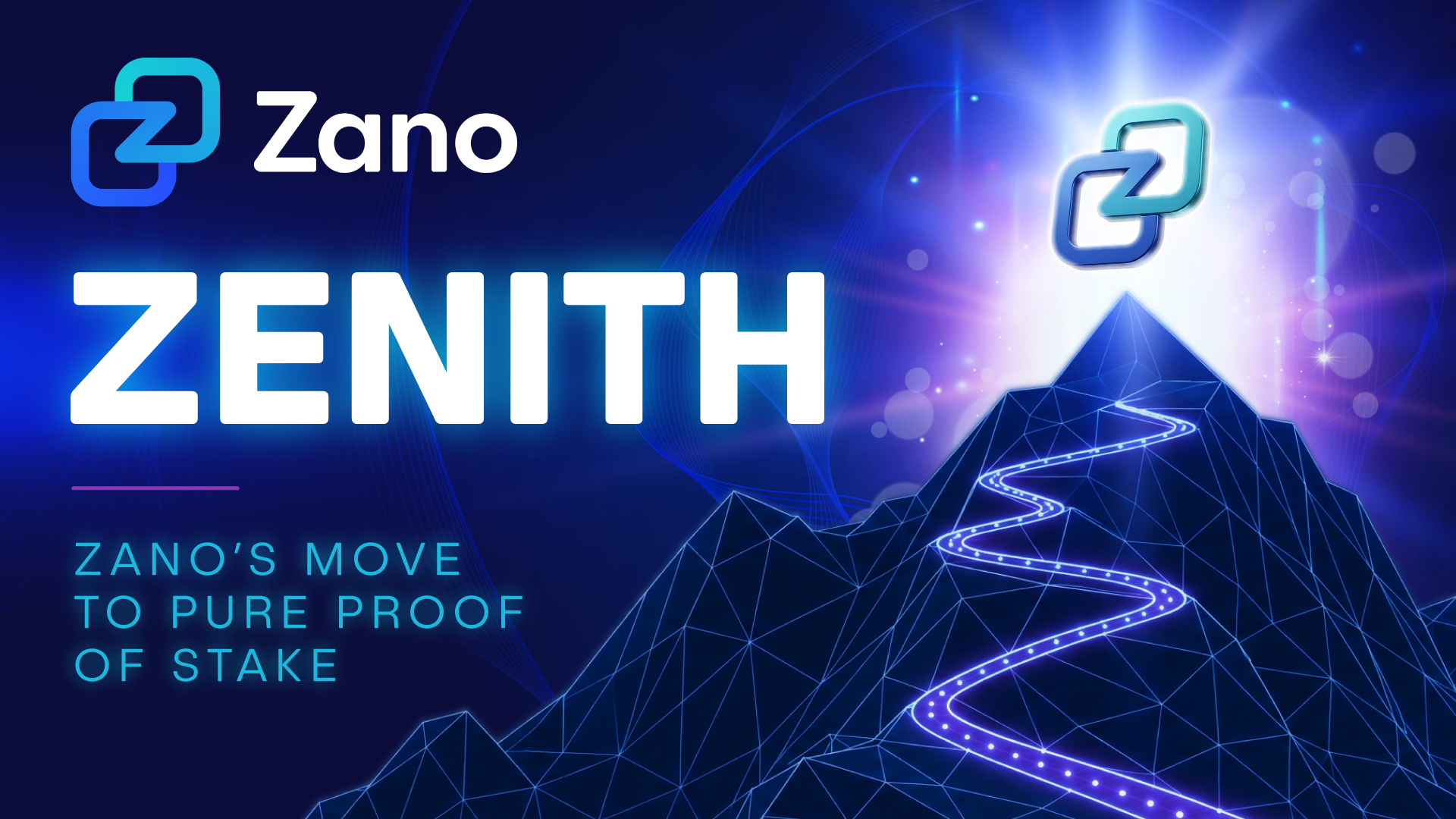
A new consensus protocol, built on the privacy foundations of Zarcanum.This isn't a pivot. It's where a road that started in 2013 finally converged. Every attempt to improve our hybrid model kept hitting the same wall: the PoW component. So we changed the question: what does the network look like if that interaction just isn't there?
Zenith is the result of more than 13 years of research into how a network can gain the benefits of modern Proof of Stake while preserving the privacy that users expect from Zano.
What changes after hard fork 7:
 Block time speeds of ~15 seconds, down from one minute
4 to 6 block confirmations instead of the current 10, carrying stronger security guarantees than the 10 we wait for today
Typical TX confirmation in 60 to 90 seconds, down from an average of 10 minutes
Ephemeral blocks keep history light, so more blocks does not mean a heavier chain
PoW emission gone, 21,600 $ZANO a month that no longer gets partially sold by miners
Staking stays private, amounts hidden, no permanent link between your outputs and youRead the full breakdown here: https://x.com/zano_project/status/2077755195962863673
Zenith whitepaper: https://github.com/hyle-team/docs/blob/master/zano/Zenith.pdf
-
Zenith looks like a major improvement for Zano, particularly in confirmation speed, removal of the PoW dependency and preservation of private staking.
My main concern is whether HF7 is also being used as an opportunity to begin Zano's post-quantum preparation.
Microsoft now targets a scalable quantum computer by 2029, while US Executive Order 14412 has already turned post-quantum migration into a current engineering programme. This does not mean that Ed25519 will necessarily be broken in 2029, but designing, reviewing, deploying and completing a blockchain migration takes years.
Zano has a specific custody exposure: every unspent output publishes a one-time public key P = xG. The permanent wallet address may remain hidden, but if elliptic-curve discrete logarithms became tractable, the corresponding one-time spending secret x could be recovered directly from the output. Faster blocks and confirmations do not remove that exposure.
I am not suggesting that a complete post-quantum version of Zarcanum and Zenith must be finished before HF7. A more realistic first step would be to use HF7 to introduce:
- explicit cryptographic-domain versioning;
- support for a hybrid custody output requiring both classical and post-quantum authorization;
- wallet migration and backup foundations;
- and a clearer separation between Zenith's consensus semantics and its current elliptic-curve eligibility proof.
Zenith is not the problem. It may be the best opportunity to make an orderly cryptographic transition possible before it becomes an emergency.
-
Balance privacy isn't the only concern for PoS, it is secondary to the issue of consensus.
PoS allows anyone with capital to purchase a large stake and this influence and eventually control the platform. This happens over time, usually slowly. Any mainstream financial institution or interested party can buy Zano and thus become a dominate stake holder, which is contrary to the privacy and freedom goals of what Satoshi Nakamoto invented blockchain tech for in the first place.
-
-
Balance privacy isn't the only concern for PoS, it is secondary to the issue of consensus.
PoS allows anyone with capital to purchase a large stake and this influence and eventually control the platform. This happens over time, usually slowly. Any mainstream financial institution or interested party can buy Zano and thus become a dominate stake holder, which is contrary to the privacy and freedom goals of what Satoshi Nakamoto invented blockchain tech for in the first place.
@fbirde If this was intended as a response to my comment, I should clarify that this is not primarily a question of balance privacy. The risk I described concerns ownership and custody: if the current elliptic-curve assumptions fail, an attacker may be able to recover or reproduce the witness material required to spend outputs or forge protocol proofs.
PoW versus PoS is a separate consensus debate. Retaining PoW would not remove the need for an orderly post-quantum migration of Zano’s transaction and custody mechanisms.
-
@fbirde If this was intended as a response to my comment, I should clarify that this is not primarily a question of balance privacy. The risk I described concerns ownership and custody: if the current elliptic-curve assumptions fail, an attacker may be able to recover or reproduce the witness material required to spend outputs or forge protocol proofs.
PoW versus PoS is a separate consensus debate. Retaining PoW would not remove the need for an orderly post-quantum migration of Zano’s transaction and custody mechanisms.
@Yep balance visibility was the main point I took away, sorry if I failed to grok the larger issue of encryption integrity.
I tend to believe the "quantum computing threat" is more fearmongering than actual reality, and I live accordingly, especially since I can't do much or anything about it personally.
I started out in crypto 13 years ago on a PoS project (BitShares & its' successors) and I came to realize the inherent flaw of PoS systems as a tool to provide financial freedom. "He who owns the gold makes the rules" is an ancient maxim that applies. PoS based consensus is corruptible by external inputs (mainstream finance) from the very institutions and forces that Satoshi Nakamoto invented blockchain tech to oppose.
-
@Yep balance visibility was the main point I took away, sorry if I failed to grok the larger issue of encryption integrity.
I tend to believe the "quantum computing threat" is more fearmongering than actual reality, and I live accordingly, especially since I can't do much or anything about it personally.
I started out in crypto 13 years ago on a PoS project (BitShares & its' successors) and I came to realize the inherent flaw of PoS systems as a tool to provide financial freedom. "He who owns the gold makes the rules" is an ancient maxim that applies. PoS based consensus is corruptible by external inputs (mainstream finance) from the very institutions and forces that Satoshi Nakamoto invented blockchain tech to oppose.
@fbirde Thanks for clarifying. Since this thread is specifically about Zenith, your broader concerns about Proof of Stake are certainly relevant. I was the one who introduced the post-quantum dimension because Zenith itself will eventually need to operate under different cryptographic assumptions.
Recent theoretical advances have substantially reduced the estimated quantum resources required to solve the elliptic-curve discrete-logarithm problem on comparable 256-bit curves. That does not mean that a practical attack exists today, but it does reduce the planning margin available for redesigning, reviewing, deploying and completing a protocol migration.
There is also a broader and worthwhile question about which consensus model is better suited to the quantum era. My own view is that a private Proof-of-Stake system such as Zarcanum and Zenith may ultimately be better positioned than Proof of Work, provided that its ownership, authorisation and eligibility mechanisms are migrated in time.
That comparison probably deserves a separate thread of its own. Ideally, HF7 should already introduce hybrid authorisation. At minimum, it should establish the transaction formats, wallet support and architectural boundaries required for an orderly post-quantum transition, rather than leaving Zano to improvise an emergency migration later.
-
@kwibs
"PoW emission gone, 21,600 $ZANO a month that no longer gets partially sold by miners"Is it safe to assume that those ZANO will now be PoS rewards?


Hello! It looks like you're interested in this conversation, but you don't have an account yet.
Getting fed up of having to scroll through the same posts each visit? When you register for an account, you'll always come back to exactly where you were before, and choose to be notified of new replies (either via email, or push notification). You'll also be able to save bookmarks and upvote posts to show your appreciation to other community members.
With your input, this post could be even better 💗
Register Login